Author: toppyhem



Home inspectors play an important role in the process of purchasing a home. They help buyers by ensuring that homes and investment properties do not contain serious issues–which could lead to expensive repairs down the road. After completing your home inspector training and earning your certification, you’ll be working with clients to examine all the details of homes–advising them accordingly. As a home inspector, it’s your responsibility to ensure that buyers are aware of the potential issues within their future home. Thus, it’s important to conduct a thorough inspection in which all problem areas are identified. Your findings will indicate the current living conditions of a home and will impact a buyer’s decision on whether to proceed with purchasing the home.
When conducting a home inspection, keeping a few important things in mind will enhance your ability to successfully account for all possible issues within a home. Check out the infographic below to discover five things you should remember once you begin your home inspector career.
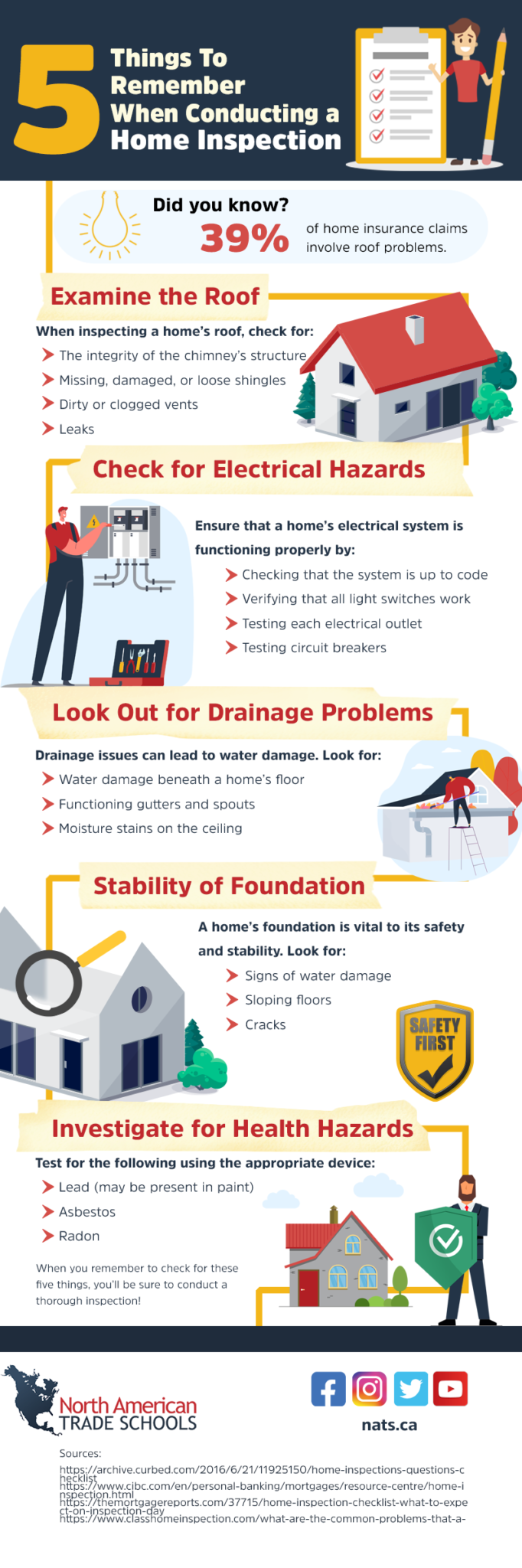
[Infographic] 5 Things To Remember When Conducting a Home Inspection
Examine the Roof
When inspecting a home’s roof, check for:
- Leaks
- Dirty or clogged vents
- Missing, damaged, or loose shingles
- The integrity of the chimney’s structure
Did you know? 39% of home insurance claims involve roof problems.
Look Out for Drainage Problems
Drainage issues can lead to water damage. Look for:
- Functioning gutters and spouts
- Water damage beneath a home’s floor (use an infrared camera)
- Moisture stains on the ceiling
Check for Electrical Hazards
Ensure that a home’s electrical system is functioning properly by:
- Checking that the system is up to code
- Verifying that all light switches work
- Testing each electrical outlet
- Testing circuit breakers
Determine Whether the Foundation is Stable
A home’s foundation is vital to its safety and stability. Look for:
- Cracks
- Signs of water damage
- Sloping floors
Investigate for Health Hazards
Test for the following using the appropriate device:
- Radon
- Asbestos
- Lead (may be present in paint)
When you remember to check for these five things, you’ll be sure to conduct a thorough inspection!
Sources:
https://archive.curbed.com/2016/6/21/11925150/home-inspections-questions-checklist
https://www.cibc.com/en/personal-banking/mortgages/resource-centre/home-inspection.html
https://themortgagereports.com/37715/home-inspection-checklist-what-to-expect-on-inspection-day
4 Best Practices for Advising Clients After Home Inspection Training
February 15, 2023
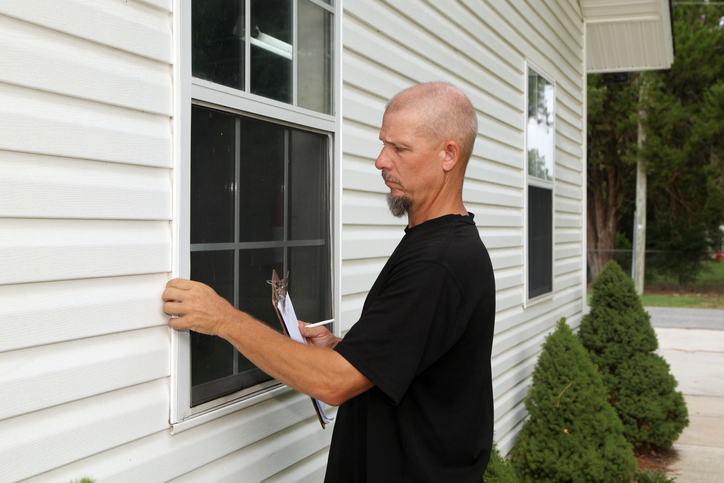
Once you become a Home Inspector, you will play an important role in a home buyer’s decision-making process, advising them on the home’s condition so they can make an informed purchasing decision. There are several best practices you should employ when advising future clients. These are rooted in excellent communication skills that your home inspector training will help you develop. Through them, you’ll be able to deliver the best possible service to your clients.
If you want to learn about these best practices, keep reading!
1. Don’t Overpromise and Underdeliver
As a Home Inspector, there will be things that you won’t be able to do while on the job. During your Home Inspector course, you’ll discover what those things are. For example, you can’t destroy or damage any property to inspect an aspect of the home. If it’s inaccessible, then it remains so. It’s important to make this clear to clients so they understand the full scope of your work and capabilities. If you tell them that you can do something when in fact, you know you can’t, you will be over-promising. Be sure to be clear in your communication because if you aren’t, this will lead to disappointment on the client’s side.

2. Maintain Professionalism After Home Inspector Training
You will inevitably encounter challenging clients during your time as a Home Inspector, but it’s how you communicate with them that’s important. You need to maintain your composure and act professionally at all times. During your training, you will learn various beneficial communication techniques. With unhappy clients, it will be vital to draw on them to navigate the situations professionally.
For example, if a client would like you to inspect an area that you’re unable to–whether it is unsafe or inaccessible–you can draw upon your communication skills to explain to the client that you’re not able to inspect that specific area and describe the reasons why. Providing a detailed explanation will allow the client to fully understand the scope of your work and why you’re unable to inspect some areas of a home. You may also suggest alternative options to the client, helping them get what they need without putting yourself at risk.
3. Ensure Clients Are Present During Home Inspections
This one might seem obvious, but it is important to try to do it with every client you have. When a client is there with you while you conduct the home inspection, they can ask questions and learn more about the process overall. If they only get the report, even if it is detailed and done thoroughly, it may not address a concern they would have had if they had been there. Utilizing the communication skills you mastered in training, you can accurately explain the situation to them during the inspection. This will help alleviate any concerns the client has and allow you to draw attention to what they should or should not be concerned about.

4. Always Be Transparent and Honest
When you become a Home Inspector, you will play a significant role in a client’s home buying decision. It’s essential to maintain transparency at all times about the situation of the home you’re inspecting. During Home Inspector training, you’ll be taught the value of transparency and clear communication with clients.
For example, you may find yourself working alongside a realtor that’s eager to make the sale. Having integrity means that if the inspection report comes up with issues, you must always be transparent about them to the client–putting them first. While the realtor may want to make the sale despite the issues, it is your responsibility to bring them to the clients’ attention regardless, allowing them to make the final decisions with a complete understanding of the home’s condition. Transparency is important in any role, but especially so when clients are making one of the most significant purchases of their lives and are entrusting you to provide all of the details needed to make an informed decision.
Are you ready to begin a Home Inspector Diploma program?
Contact NATS to learn how you can get started.
A Day in the Life of an Apprentice Boilermaker After a Welder Diploma Program
February 10, 2023

Boilers are large pressure vessels that create steam for energy. This energy is used to create paper, process foods, and generate electricity. Specialized welding skills are needed for the construction, installation, maintenance, and repair of boilers, and if you’re considering welding training, a boilermaker role could be a good option. After completing a reputable welding program, you’ll need to finish an apprenticeship program, where you’ll hone your skills and make the professional connections needed to launch your career as a journeyman boilermaker.
Typically, Canadian apprenticeship programs last a total of 3 years. They usually occur in 12-month stretches between in-cass instruction periods. Students value apprenticeships because they offer them the perfect opportunity to gain hands-on experience and earn money simultaneously. Read on to learn what it might be like to complete a boilermaker apprenticeship.
Start With Safety Measures After a Welder Diploma Program
As with all occupations in the trades, boilermakers must prioritize their safety. The beginning of your day as an apprentice boilermaker is the perfect time to ensure that you’re wearing the proper personal protective equipment and that your environment is safe. Your role can expose you to several hazards, such as flying objects, dust, splashed acid, sharp objects, the sun, and heavy machinery, which can harm your eyes, head, feet, respiratory system, and skin. After completing your welder diploma program, ensure that you wear eye protection, grade 1 protective footwear, sun protection, air-purifying respirators, and high-visibility clothing. Additionally, make sure that you’re provided with a safety harness when you’re working at heights.

Aid the Construction and Installation of Boilers
One of your principal learning objectives as a boilermaker apprentice is the construction and installation of boilers. These duties require several skills that you’ll have plenty of opportunities to practice throughout your apprenticeship. Some of these skills include blueprint reading, cutting metal, fitting and welding metal together, and directing crane operators during installation and repair. After welding technician courses, you will often begin by shadowing and assisting. With time and experience you’ll be able to complete these basic boilermaker duties all on your own. In addition to construction and installation, maintenance will be another important aspect of your work as a boilermaker apprentice.

Apprentices Keep Boilers Clean as a Maintenance Practice
Boiler cleaning improves the performance of the machine. By removing limescale and soot buildup, you’re preventing heat loss, which reduces downtime for the boiler and extends its lifespan. This is a cost-effective practice that makes your role valuable to companies that save significant sums of money with your services. As a boilermaker apprentice, you will learn to conduct regular visual inspections, test the effectiveness of a boiler to determine whether it needs maintenance or replacement, and clean boilers. You will likely use cleaning solvents, scrapers, and wire brushes to complete this task.
Learn the fundamentals of welding in our state-of-the-industry facility and start your successful boilermaker career with us.
Are you ready to begin welding courses?
Contact NATS to learn how you can get started.

An HVAC Technician is a skilled professional that installs, repairs, and maintains, heating, ventilation, air conditioning, and refrigeration units. If you are considering becoming an HVAC Technician, there are certain safety principles you will need to know and remember. Once you start your career, you will find that you’ll be working with noxious gasses and electrical systems, and as such, you’ll need to remember safety protocols to avoid any harm. Read on for some safety practices you’ll want to remember throughout your training and career.
Wear PPE After HVAC Technician Training
As an HVAC Technician, you are likely to be exposed to noxious fumes, as well as other particles such as dust, debris, and chemicals which may cause harm. It is essential always to wear personal protective equipment (PPE) while you work. For instance, a respirator will help protect you against fumes, and safety goggles can help protect your eyes against any debris or harmful liquids. Other important PPE you may need as an HVAC Technician includes:
- Safety gloves
- A hard hat
- Non-slip shoes
- Earplugs
During your HVAC Technician Diploma program, you will learn the importance of protective gear, including how it should be worn and why it is needed in different scenarios. For example, wearing earplugs when working in a loud environment can help avoid damaging your hearing. Always wearing your safety gear on the job will help prevent you from suffering serious harm.

Be Cautious When Handling Chemicals
An important safety practice to always consider while working as an HVAC Technician is to be cautious with chemicals. You will be working with chemicals daily, and some, such as solvents and refrigerants, can be very harmful if not handled correctly. They may cause burns or in some severe cases, poisoning. During HVAC Technician training, you will be taught how to handle these chemicals safely.
Practical examples will be given and overseen by instructors, where you will need to dispose of, replace, and transport chemicals safely. This will be done using the knowledge of rules and regulations you learn during your training. For example, you’ll learn how to remove and store refrigerant chemicals safely.

Turn Off the Electricity While you Work
When working with units that have a water system or have general electrical issues, it is safer to turn off the main circuit breaker before starting work. Water is a conductor of electricity and can cause electrocution. Water leaking onto the unit you are working on may also be damaging to the unit, as it may cause a short circuit. This can be not only damaging for the unit but is a safety and fire hazard, as well. Additionally, it will be essential to analyze a unit before you begin working on it to see if there are any fluid leaks. This will help you better understand if you need to turn off the main circuit breaker.
The HVAC training you receive at NATS will help you identify leaks, teach you how to fix them, and help you understand the safety practices to follow throughout your career.
Are you ready to begin training for your HVAC Technician career?
Contact NATS to learn how you can get started!
Interesting Career Paths to Explore After Construction College
January 25, 2023

The construction industry consists of individuals with varying skills. All of these skilled workers play a role in making sure that construction projects meet the specifications outlined in their planning. A good construction program will prepare you to meet the needs of the industry, helping you thrive in your career.
During the construction program at NATS, you will learn the skills to fulfil several electrical industry aspects successfully. You will also learn residential wiring, code interpretation, conduit bending, electrical motor theory, service installation, print reading, and electronic controls. These are skills you can apply to various career paths upon completing the program. Read on to learn more about the careers that will be available to you after your training.
Become an Electrical Technician
An electrical technician is a skilled worker that focuses on installing wiring, ensuring that the wiring works correctly, and installing circuits and outlets to power electronics, lights and other equipment in a building. Professionals in this career will need to be able to read electrical blueprints and follow electrical codes and regulations. During construction training, you will learn these skills through practical, hands-on training. For instance, you’ll complete practical, real-world projects installing wiring similar to what you will see when working as an electrical technician.
Becoming an electrical technician will create work opportunities for you in both residential and commercial construction. You will also be able to work in a company’s maintenance department and see to the electrical needs of the company as they happen.

Become an Electrical Service Technician After Construction College
As an electrical service technician, you will specialize in ensuring that electrical equipment and systems remain operational and function as they need to. You may be required to modify systems or repair them completely.
During construction college, you will learn different wiring methods for conduits, tubing and bends. This will help you rewire electrical devices where the wiring has corroded or is no longer functional. You will also learn how to apply the Canadian Electrical Code (CEC), ensuring that repairs and rewiring are done to the standard required.
Become an Electrician by Continuing Your Apprenticeship
As a graduate earning your Construction and Maintenance Electrician Diploma, you will be an apprentice electrician. This will allow you to continue studying the electrical trade to become a qualified electrician. While becoming a qualified electrician may be longer, it is worth considering. This is primarily due to the demand for qualified electricians in Canada. Job prospects for electricians in Canada are good and look to remain this way for years to come. Becoming a fully qualified electrician will also open other opportunities, including starting your own business.
The training you receive during your diploma program will equip you with the foundations of being an electrician. You will learn electrical theory and principles and how to apply them practically. You will also learn the foundations of what an electrician needs to know, such as wiring, the CEC, and safety principles, ensuring you are well-equipped to continue your studies to become a fully-qualified electrician.

Are you ready to begin your construction courses?
Contact NATS to learn how you can get started.

Home inspectors play a crucial role in the home-buying process by providing information to prospective home buyers about the conditions of the properties that they are interested in purchasing. These professionals carefully analyze every aspect of a property, including the electrical system, plumbing, roofing structure, heating, heating pumps, and the overall exterior and interior. A home inspector may also suggest solutions to problems they may see so that future homeowners can anticipate other costs associated with the house.
One of the great things about becoming a home inspector is that you can work independently and start your own business. However, starting a home inspector business can be challenging, so a clear plan needs to be devised and executed for the business to succeed. Are you considering starting your own business after home inspector training? Read on for some essential tips to consider.
Develop a Plan for Your Future Home Inspection Business
Every new business should have a plan set up to help guide the journey. A clear outline and goals will help drive your business idea forward after home inspector training. Your training will provide the knowledge and expertise you’ll need to thrive when starting your own business since you will have the skills to carry out jobs successfully.
A business plan will be useful for approaching banks and investors, walking them through your services, financial projections, marketing plans, and your overall strategy for achieving success. A good business plan must include the following components:
- An executive summary
- A description of your business
- Strategy and market analysis
- A good marketing and sales plan
- Your business management plan
- Descriptions of your services
- A thorough analysis of your competition
- Details on how you plan to operate your business
- Your financial needs and projections
- Documents and other items investors might want to see (permits, financial documents, marketing materials, etc.)

Effective Marketing That Sets Your Home Inspection Business Apart
Marketing is an effective way to promote your home inspection business so that home buyers are more likely to find your business instead of a competitor. Utilizing social media and a well-designed website will allow you to stand out from the competition.
Posting regularly and staying active on social media can help you build brand recognition as well as your following. Some ideas for social media posts include providing home buying and inspection tips to prospective clients and sharing customer reviews and testimonials. You can also share general content about your business and yourself, including any achievements from your home inspector courses. Some social media platforms you can make use of include Facebook, Instagram, and TikTok.

It’s also important to have a professional website for your business, where potential clients can find your contact information online, as well as other important details about your business, including prices, services, and more. Additionally, once you have a website, you can delve deeper into your marketing by creating a blog page with helpful information for clients, and you can optimize your site for SEO so that your business will be easier to find on search engines.
Contact Real Estate Agents After Home Inspector Training
Connecting with real estate agents can be mutually beneficial. Since real estate agents have access to multiple listings and clients interested in buying homes, they are in an ideal position to recommend your business to their clients. On the other hand, a home inspection is a critical part of buying a home, and real estate agents know that clients will need to have one conducted, so knowing a home inspector they trust and can recommend benefits them as well.
Maintain relationships with people you meet in your home inspector courses, as well as your clients and real estate agents you meet or have already worked with. This will help you meet more people in the industry and continue to build meaningful connections, and grow your network.
Do you want to become a home inspector?
Contact NATS to learn how you can get started.
Blueprint Reading: 4 Best Practices to Keep in Mind After Cabinetmaking Training
January 10, 2023

Cabinetmaking and other construction projects require detailed plans to ensure that all key elements are in the right place, that the project is compliant with safety codes, and that it meets customer expectations. That’s where blueprints come in. They are two-dimensional technical drawings that illustrate the design of a project in detail. By looking at a blueprint, you should have a good idea of a project’s dimensions, materials, and the exact placement of each component.
Without any experience in cabinet making or construction, blueprints may seem complex at first glance; however, with the right training, you can hone this essential skill and approach each project confidently. Read on for blueprint best practices you can keep in your arsenal throughout your training and career.
1. Always Begin With the Title Block
The title block will stand out to you when you look at a blueprint after Cabinetmaking training. It contains basic introductory information that will come in handy throughout your project. That’s why it’s an excellent idea to look at the title block before you begin a project. In addition to the project name and number, this part of the blueprint contains contact information for the designer in case you spot an error or anything that needs further clarification. You’ll also see an index which is a reference list of all the drawings in the set of plans.

2. Study the Legend to Understand Your Project Fully
Similar to what you would see on a map, the legend on a blueprint decodes the symbols found throughout a design to represent key components of the project. While there are universal symbols, there are also industry-specific symbols, and some companies even have their own custom symbols. Studying the legend right away will make it much easier to understand your blueprint since you’ll know exactly what each symbol represents. The legend may also contain the standard scale to give you a good idea of the project size.
3. Pay Close Attention to the Notes
When interpreting a blueprint after Cabinetmaking school, you’ll find that notes are often littered throughout a set of plans. For this reason, it’s wise to set time aside for a thorough reading of the entire project plan to ensure that you don’t miss any important specifications. As they study the notes in a blueprint, many experts make notes of their own with any questions and concerns about the design. It’s best to clarify any unknowns before getting started to ensure that no materials, power, or time are wasted.

4. Develop a Trained Eye in Cabinetmaking School
As with most construction skills you’ll develop in training, and throughout your career, mastering blueprint interpretation will require a lot of practice. For this reason, you’ll want to choose a Cabinetmaking training program that provides ample opportunity to read and execute plans effectively. With time, you’ll develop a trained eye and reading blueprints will become second nature. With this skill set, which you’ll develop in our Cabinetmaking Diploma Program, you can go on to enjoy an exciting career in cabinetmaking and installation, store fixture making, architectural millwork, and more.
Ready to earn your Cabinetmaking Diploma?
Contact NATS for more information!
3 Reasons to Take a Global Supply Chain & Logistics Management Online Program This Year
January 03, 2023

Working in the logistics industry could involve planning, implementing, and managing the transportation of goods and services within the supply chain. Workers in this field are the heart of global trade, and in effect, their work has a significant impact on the economy. This career path offers a variety of workplaces to explore and a chance to work in an exciting, fast-paced field. If logistics management interests you, the first step toward your dream career is the right training.
North American Trade Schools offers an online training program that equips students with the skills they need to work in a dynamic career. Keep reading to learn three great reasons to take Global Supply Chain and Logistics Management training online this year.
1. Enjoy High Demand and Security in a Growing Field
Since 2020, we’ve been seeing significant growth in the logistics field that is predicted to continue until 2025 and peak at 3.5%. According to experts, this increase results from a fast-growing manufacturing industry fueled by e-commerce and booming construction, pharmaceutical, and healthcare industries. This is an excellent time to position yourself as a qualified logistics management professional and enjoy a position that allows you to enjoy job security. Our Logistics Management Online Program will leave you prepared to take the Canadian International Freight Forwarding Association certification exam and earn the Lean Six Sigma Yellow Belt certification, both reputable credentials that will set you apart as a competitive candidate in your freight management job search.
2. Work in a Dynamic Global Field With a Logistics Management Diploma
Logistics management is the ideal career choice for those who want a dynamic, interesting career, as it presents new challenges daily. For this reason, you’ll never be bored as a professional in this field. In addition, the industry is international, and in some cases, the opportunity to travel may be on the table to deal with contract negotiations, meet with clients overseas, and purchase goods. After taking our logistics management courses, you’ll gain a solid understanding of both customs and global trade compliance to prepare you with a profound understanding of international trade.

3. Get Real Life Experience With a Final Case Study Project
Students in the Global Supply Chain and Logistics Online Program finish logistics management training with a capstone project that allows them to research a real-life logistics business problem. They will have the opportunity to use the knowledge and skills they’ve developed in classes to develop an effective solution like they will on the job.

If you’re considering a career in global logistics management, you can receive the training you need flexibly and from the comfort of your own home. We understand that many of our students have other obligations, and we want to ensure that our programs are accessible to as many career seekers as possible. Start your journey to career success today.
Ready to earn a Logistics Management Diploma?
Contact NATS for more information!

A roof is a solid financial investment, but it’s not one that homeowners typically want to make immediately after purchasing a new home. Unfortunately, some homeowners find themselves having to deal with the fallout of a hasty purchase long after the deed has exchanged hands.
As a home inspector, it’s up to you to help your clients spot structural defects and other problems in any residence they’re looking to purchase. They will be counting on you to ensure that they don’t make a purchase that poses a financial and health risk to them.
A roof can have a variety of problems, especially if it’s getting old. Here are some of the most common ones to be on the lookout for as a home inspector.
1. Your Home Inspector Training Will Help You Spot Minor Leaks
A roof is approaching the tail end of its lifespan when it starts to leak. During the rainy seasons, leaks in a roof are easy enough to spot. On the flip side, you’ll need the insights gained during your home inspector training to spot leaks when it is not raining or snowing.

A leaky roof can damage the ambiance of a home, as well as the properties in the home. Even worse, a leak constitutes a health hazard to all the occupants of that home. And since the roof in question will need replacing, it is a major financial drain. As a home inspector, you’ll need to examine the roof of any property for signs of leakage. Pay particular attention to discolorations on ceilings; these are indications that water has been trapped on that spot. If any part of the roof is sagging, it’s likely to have suffered water damage.
2. Dark Spots on Ceilings and Walls
Dark spots on the ceilings and walls are a big red flag. These discolorations are visible signs of the presence of mould on the roof of the property. Mould is hard on the eyes, but it can do much worse than pose aesthetic problems. It can exacerbate respiratory conditions and ultimately damage the structural integrity of a home.

If you notice dark spots or damp smells in a house that your client is interested in purchasing, take a few extra moments to carry out a careful examination of those spots. Chances are those areas have been afflicted by a serious case of mould contamination. In that case, it would be in the best interest of your client to steer clear.
3. Granules in the Gutters
Granules coming off a newly-installed roof are nothing to worry about. However, if the roof is getting on in age, it should trigger warning bells during your home inspector career.
Granules appearing in the gutter indicate that the roof’s shingles are damaged. Without the granules, the shingles on a roof would deteriorate considerably faster, and the roof would need to be replaced earlier. Loose, curled, or damaged shingles provide the roof with inadequate protection against the elements–so it’s important to fix that problem earlier rather than later.
Are you ready to become a home inspector?
Contact NATS to get started.

Home renovation is a rewarding career that allows workers to use their technical abilities, problem-solving skills and creative flair. If you dream of helping homeowners customize their spaces and improve your own, home renovation training is an excellent idea.
Naturally, you may be asking yourself what career opportunities await you after graduation. Here are three interesting career paths to explore as a home renovation expert.
1. Become a Carpenter with a Home Renovation Diploma
If you enjoy working with your hands, carpentry could be a lucrative, enjoyable outlet for your talents and interests. The work of carpenters supports the construction industry as they build, install, and repair wooden structures.
As a carpenter, you’ll be building foundations, installing floors, installing roofing systems, repairing wood structures, interpreting blueprints, and more. This role will require you to complete an apprenticeship and pass an interprovincial exam, leaving you qualified to work as a journeyperson and start gaining valuable experience.

2. Start Your Own Business After Home Renovation College
Entrepreneurship allows you to create your own schedule and remove limitations on your earning potential. Starting your own home renovation business will require you to put a capable team together, network, build a solid portfolio, and hunt for clients. This is the perfect path for independent self-starters who want to build a successful company from the ground up.
When you attend home renovation school, you’ll have access to hands-on labs, where you’ll learn all the fundamentals of plumbing, carpentry, interior and exterior finishes, cabinetmaking, stair construction and installation, and roof construction. In addition, you’ll learn how to use equipment like table saws, mitre saws, band saws, drill presses, and a wide range of other power and pneumatic tools in our state-of-the-art facilities.
3. Become A Property Developer After Home Renovation School
Property developers leverage their vision, planning skills and teams to purchase, develop and sell real estate. This is an extremely lucrative and interesting way to use your home renovation skills.
While there are no formal requirements for starting a property development career, there are many moving parts. As a property developer, you’ll need to successfully identify worthy investments and use your understanding of the market to plan for the creation of attractive results for buyers.
Once you have the right training and experience in the construction industry, you’ll need to ensure that you’ve optimized your borrowing capacity and then assemble a team, study the market, find your niche, and network as much as possible. After completing these steps, you’ll be ready to develop your very first property.
Where do you begin? A home renovation college can be the perfect starting point for an exciting career in property development.

Ready to receive your home renovation diploma?
Contact NATS for more information!