Author: toppyhem




Welding is undoubtedly worth exploring if you’re looking for an interesting career path that allows you to use your hands and create tangible results. Welders use metal to build various structures, from intricate decorative pieces to reinforcements for our bridges and large buildings. Several industry-specific competencies and soft skills are required for success as a welder. As with any career path, quality training is an excellent place to start.
North American Trade Schools offers a comprehensive Structural & Pressure Vessel Welder Diploma Program to equip you with all of the skills you’ll need to be employed in the welding field with confidence. Math for welding, health and safety concerns, and welding theory are just a few topics covered at length in our program. In addition, students can practice their welding skills in practical labs. Keep reading to discover what skills you can expect to learn in our training program and how they’ll help you succeed.
1. Physical and Administrative Capabilities Are Required
Welding is a physical job that requires a fair amount of strength and endurance. Everyday welding tasks include lifting, twisting, and bending to assemble and dismantle heavy-duty equipment. Welders also benefit from a steady grip as they must hold a torch steady for extended periods. After welder training, your eyes will be as important as your hands. Excellent depth perception, hand-eye coordination, and close vision will help you create consistently accurate results.
While having a physique is beneficial, administrative skills are equally as important.
Welding is a project-based career path. To succeed, you should possess excellent project management skills. This involves effective time management to meet deadlines, good project planning, organization, thorough documentation practices, and teamwork.

Though much of your work as a welder will be done independently, effective communication skills are essential to your productivity since you must collaborate with other team members, supervisors, and others working on your job site or factory.
2. Attention to Detail and Numerical Skills Help in Welder Training
Welders are required to produce results with minimal flaws. If you’re naturally detail-oriented, you’ll be well prepared to notice and fix grease buildup, corrosion, bubbling, and cracks on your work. As a welder, parts, material, and equipment inspection will be a regular part of your role, which requires taking note of issues quickly.
Your attention to detail will also help you maintain a safe work environment since you will often work in dangerous surroundings after welding college. In addition, flaws in your work could have public safety implications, so it’s important to make double and triple-checking a habit. Like other welding skills, you will have plenty of opportunities to refine your attention to detail during training as you learn what imperfections to look for in materials, equipment, and your projects.
Though you won’t need to understand advanced algebra to succeed as a welder, numerical skills are handy. Our Structural & Pressure Vessel Welder diploma program covers basic math for welders, which will help you calculate dimensions, interpret sketches, read blueprints accurately, and understand two- and three-dimensional diagrams. Good math skills will help you with your day-to-day welding tasks, logical reasoning, and problem-solving on the job.

3. Mechanical Skills Will Help You Use Tools Properly
Welders work on various projects and must understand the technology and tools that will make their work more accessible and more effective. In our program, you will have the opportunity to practice using welding equipment in a state-of-the-industry lab environment under the supervision of our expert instructors.
Students learn how to use modern tools for welding, commonly used techniques like gas metal arc welding, gas tungsten arc welding, flux cored arc welding, and shielded arc metal welding. If you’re mechanically inclined and enjoy learning about new technologies, this part of your welding training will undoubtedly be fulfilling.
If you have what it takes to become a successful welder, start training today! The Structural & Pressure Vessel Welder diploma program will help you transform your natural aptitudes into highly marketable skills in an exciting industry!
Are you ready to earn your welding diploma?
Contact NATS to learn how you can get started.
The 7 Cs Of Supply Chain Management For Those in Logistics Courses
May 09, 2023
In many ways, Supply Chain Management is the backbone of the economy. It’s the process of overseeing the production of goods and services as they evolve from an idea and raw materials into a finished, marketable product. The transport and storage of materials, the storage of finished products until they sell, and the collection of sales data also play a significant role in supply chain management. Innovative companies rely on well-managed supply chains to significantly reduce operating costs and inform their marketing efforts to drive more sales.
Many factors are involved in effective supply chain management, so principles have been implemented to guide professionals seeking to streamline the process. One research paper titled Journeys, Not Destinations: Theorizing a Process View of Supply Chain Integrity borrows research by Thomas Maak, who conceptualized the 7 Cs of corporate integrity. The paper translates Maak’s corporate research into a supply chain context. Keep reading to learn how you can provide value in the logistics industry using these seven principles and attain your career goals.
The Basic Components of Supply Chain Management
Before you learn about the principles of supply chain integrity, it’s essential to understand the basic components of supply chain management systems. When you can master the following five elements after studying Logistics Operations Online, you will be a valuable asset to any logistics team.

- Planning: Planning in a supply chain management system involves managing all resources required to meet the customer demand of a company and setting up metrics that measure progress.
- Sourcing: This involves choosing suppliers that meet the needs of a company. Cost, efficiency, and ethics are a few factors to consider.
- Manufacturing: This component of supply chain management involves coordinating activities for accepting raw materials, producing the product, quality assurance testing, and packaging.
- Delivery and Logistics: This involves receiving orders, coordinating invoices, receiving payments, and scheduling deliveries.
- Returning: Have systems in place to return unwanted or excess products.
The 7 Cs of Supply Chain Integrity for Those Taking Logistics Courses
Applying the 7 Cs of supply chain integrity to the five components discussed above can save companies plenty of time, money, and effort, making your team a sought-after solution for businesses and their customers. Keep the following principles in mind after completing your logistics courses.

- Commitment: Stay committed to meeting relevant customer needs, addressing challenges, and exercising social responsibility related to the environment and ethical trade.
- Content: Specify ethical and responsible behaviour guiding principles within your logistics team and supply chain partners.
- Coherence: Stick to the guiding principles of your logistics team and readily invest in efforts that support them – even through financial challenges.
- Context: Seek partners with similar values and become bound to common ethical standards.
- Conduct: Have specific systems in place to carry out guiding principles. These should be both preventive and corrective.
- Consistency: Keep promises to companies and make provisions to achieve expected outcomes.
- Continuity: Reflect your enduring dedication to ethical and responsible practices through efforts that require steady progress over several years.
Get the Skills You Need to Apply the Principles of Logistics Best Practices
Our online Supply Chain and Logistics Operations Program provides students the skills they need to succeed in the industry. Learn industry software and computer applications, communications, purchasing and contracting, order management, operations planning, and warehousing.
The delivery method affords students flexibility thanks to our asynchronous structure while adequately preparing them to earn their Canadian International Freight Forwarders Association (CIFFA) certification. Courses were designed with Quality Matters best practices for online learning. They include engaging online activities and video conferences with instructors that ensure a thorough understanding of course content. Start your dream career with us, and remember the 7 Cs of supply chain integrity along the way!
Are you ready to earn your Logistics Diploma?
Contact NATS to learn how to get started!
3 Paint Application Tips to Use After Home Renovation Technician Training
April 25, 2023

Painting is one of the final stages of every building or home renovation job. However, it’s also one of the most delicate tasks. Get it right, and you’ll have applied the perfect finish to your masterpiece and crafted the perfect ambience for the home. On the other hand, if you get it wrong, it can take the shine away from all your hard work up to that point.
If you’re considering becoming a Home Renovation Technician, you likely have an eye for design and the ability to bring a client’s vision to life. After completing your training, you may use paint application techniques to enhance the finished look of a project. In this blog post, we will discuss three paint application tips you can use after completing your home renovation technician training.
1. Prepare the Surface After Home Renovation Courses
Before beginning any paint application after your Home Renovation Technician training, it is crucial to prepare the surface properly. Preparing the surface means cleaning, sanding, and priming the area to ensure the paint adheres well and looks smooth. Cleaning the surface may involve removing any dirt, debris, or peeling paint that may be present. Sanding the surface helps to smooth out any bumps or roughness that may interfere with the application of the paint. Finally, priming the surface will help the paint stick and ensure the colour appears consistent.
It is important to note that different surfaces may require different preparation methods. For example, wood surfaces may require more sanding than metal surfaces, and concrete surfaces may require a special primer. Knowing the correct preparation methods for different surfaces can help you achieve a professional-looking finish.
2. Use the Right Tools and Techniques
Using the right tools and techniques can also make a significant difference in the outcome of your paint job, as you will learn in your Home Renovation courses. There are a variety of tools available for paint application, including brushes and rollers. Each tool has its own strengths and weaknesses, and it is important to choose the right tool for the job. For example, brushes are best for detail work and edging, while rollers are ideal for large, flat surfaces.

In addition to using the right tools, it is important to use the correct techniques. For example, when using a brush, you should use long, smooth strokes to avoid visible brush marks. When using a roller, you should roll in a “W” shape to ensure even coverage. Knowing the correct techniques for each tool can help you achieve a professional-looking finish.
3. Choose the Right Paint
The type of paint you choose can also drastically affect how your paint job ends up. There are a variety of paint types available, including latex, oil-based, and specialty paints. Each type of paint has its properties and is best suited for different surfaces and applications. Latex paint is best for interior walls, while oil-based paint is best for exterior surfaces. Specialty paints, such as chalk or metallic paint, are ideal for adding texture and interest to a project.

Choosing the right paint type is equally as important as choosing the right colour and finish. The colour should complement the rest of the room or project, while the finish should match the desired look and durability. Choosing the right paint can help you achieve a professional-looking finish that will last years.
Are you interested in earning a Home Renovation diploma?
Contact NATS to learn how to get started.
Logistics Management Duties You’ll Perform After Your Training
April 18, 2023

The success of any organization that deals with the transportation of goods and services depends heavily on the ability of the logistics management team to perform their duties effectively. It involves the coordination and management of resources to ensure that products are efficiently and effectively transported from one location to another. This process includes planning, implementing, and controlling the flow of goods, services, and information from the point of origin to the point of consumption.
Logistics Management is a complex and challenging field that requires a broad range of skills and knowledge. After training, logistics managers are responsible for several duties that require knowledge of various aspects of logistics management. In this blog, we’ll explain some of the key Logistics Management duties you’ll be required to perform after your training.
Inventory Management After Logistics Management Training
One of your most critical duties as a logistics manager is the management and monitoring of inventory levels. Inventory management involves the planning, organizing, and controlling of inventory levels to ensure that the right quantity of goods is available at the right time. Effective inventory management helps to minimize stockouts and overstock, which can be costly for a business.
As a logistics manager, after Logistics Management training, you must analyze inventory data and forecast demand accurately to maintain optimal inventory levels. You should also be familiar with inventory management techniques such as just-in-time inventory management, economic order quantity, and safety stock levels.

Warehouse Management After Logistics Management Courses
Warehouse management is another of your primary responsibilities as a logistics manager. Warehouse management involves overseeing the operations and functions of a warehouse or distribution centre. This includes receiving and processing incoming stock and materials, picking and filling orders from stock, packing and shipping orders, and managing and maintaining inventory levels.
A logistics manager must ensure that the warehouse operations are running smoothly and efficiently. To do this, they must be familiar with warehouse management systems, inventory control, and the latest technologies used in the industry.
Transportation Management
The main purpose of the Logistics Management industry is the successful transportation of goods and services from one point to another. Therefore, transportation management will be one of your core concerns as a logistics manager. No matter where you end up working, you’ll most certainly be tasked with ensuring that goods are transported safely, efficiently, and cost-effectively.

To achieve this, you will need to have a good understanding of transportation modes, such as trucking, shipping, and air freight. You will also need to have a good understanding of transportation regulations and requirements, such as customs clearance procedures and safety regulations.
Supply Chain Optimization
Logistics managers are also concerned with ensuring the viability, sustainability, and profitability of the business. In other words, you may have to keep a close eye on the business’s bottom line when making decisions. This involves ensuring that all activities related to the movement of goods and services are integrated and optimized to achieve the best possible outcome for the business. This can involve coordinating with suppliers, customers, and other stakeholders to ensure the supply chain operates smoothly.
The key is understanding supply chain management principles and techniques, such as lean manufacturing, just-in-time inventory management, and vendor-managed inventory. You will also need to be able to analyze data and make decisions based on that data to improve supply chain performance.
Are you Interested in Logistics Management courses?
Contact NATS to learn how to get started.

If you’re thinking of starting an HVAC career, there are many tools you’ll need to get acquainted with, as you’ll use them both during your training and throughout your career. In addition to basic hand tools that most tradespeople need to complete basic tasks, such as screwdrivers, power drills, hammers, and pliers, there are several industry-specific tools you’ll use. With the knowledge and skill to use these tools, your work will be done more efficiently. Read on for a brief introduction to some standard HVAC tools you’ll use after training.
Carbon Monoxide Detectors Are Essential for Safety
As an HVAC technician, you’ll come into contact with many different sources of carbon monoxide gas. These include leaking chimneys, back drafting from gas water heaters, wood burners, furnaces, generators, and any poorly maintained combustion device. Inhaling this deadly molecule deprives the body of oxygen, and in the case of carbon monoxide poisoning, you may only notice some mild symptoms like headache, dizziness, or fatigue. Since carbon monoxide gas is undetectable, you’ll need to use detectors. These devices sound an alarm when an unsafe amount of carbon monoxide is detected in the air. They can be life-saving.
Refrigeration Gauges Allow You to Manifold Gas and Liquid Pressure
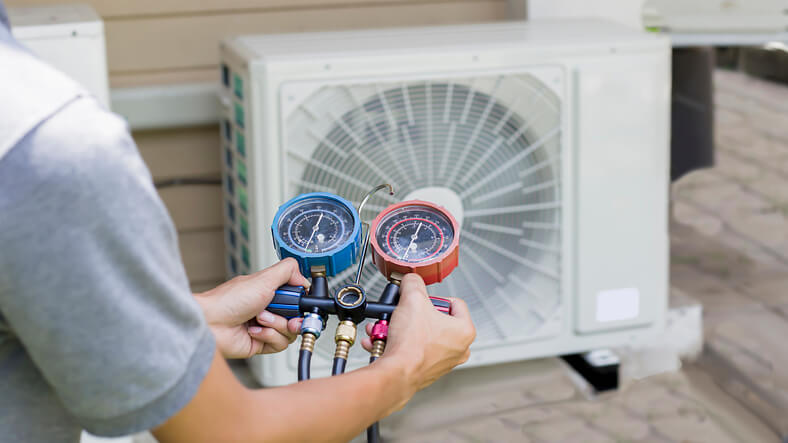
After HVAC Technician training, you’ll use manifold gauges frequently. In fact, many consider them essential HVAC tools. They measure the pressure of liquids and gasses in a cooling system and are used primarily as a diagnostic tool, alerting you to any problems with the operation of a system. They can also be used as a service tool, releasing moisture, debris, or contaminated refrigerant from a system. Using a manifold gauge, you can add refrigerant to a cooling system. Digital gauges offer more efficiency and accuracy.
You’ll Use a Multimeter Regularly After HVAC Technician Training
Multimeters are essential tools that you’ll regularly use after completing HVAC courses. They are used for safety reasons to detect electrical current and notify you of the presence of voltage in order to protect you from electrocution. Multimeters also aid in the troubleshooting of electrical components within a cooling system, like switches, wires, and outlets. It’s important that you use a multimeter specifically designed for HVAC technicians with a thermocouple (air temperature sensor) with a 1000-degree range. HVAC multimeters should also have attachments that are compatible with the electrical components of ventilation systems.

HVAC Software Will Help You Streamline Your Workflow
As an HVAC technician, your success depends greatly on your ability to manage your time, keep track of your invoicing, and maintain good customer relationships. Industry-specific business software can help you greatly improve your efficiency. Software tools that feature drag-and-drop scheduling streamline the invoicing process, and customer relationship management technology are great options you might work within your career.
Our HVAC Technician diploma program is designed to prepare students for the G3 and G2 Gas Technician exam with hands-on training from expert instructors. North American Trade Schools is accredited by the Technical Standards and Safety Authority (TSSA). The TSSA promotes and enforces public safety in Ontario. Our HVAC Technician Diploma Program and all of the career training programs we offer meet the standards set by the TSSA, meaning that you can trust us to provide all the skills needed to become a certified HVAC technician.
Are you ready to attain your HVAC Technician diploma?
Contact NATS to find out how you can get started.
4 Essential Skills You’ll Learn in Logistics Management Training
March 21, 2023

Logistics management involves planning, implementing, and controlling the efficient and effective movement of goods, services, and people. It requires a unique set of skills and expertise that can only be developed through proper training. Our Global Supply Chain and Logistics Management online training at North American Trade Schools (NATS) can provide the necessary knowledge and skills to excel in this field. In this blog post, we will discuss four essential skills you will learn in Logistics Management Training.
1. Supply Chain Management Skills
Supply Chain Management is managing the flow of goods and services from the point of origin to the point of consumption. It includes the coordination and integration of all activities involved in the production and delivery of goods and services.

Logistics Management training provides a comprehensive understanding of supply chain management principles and techniques, including inventory management, demand forecasting, and transportation planning. Through supply chain management, logistics professionals can ensure that goods and services are delivered to customers promptly and cost-effectively.
Logistics Management training exposes you to the finer details of supply chain management, helping you understand the whole process and gain essential knowledge that will make you a valuable asset to your organization.
2. Operations Management After Logistics Management Training
Operations management is the management of the processes and resources that are used to produce goods and services. It involves the planning, scheduling, and controlling all activities required to produce a product or service. Logistics Management training provides individuals with the knowledge and skills to manage operations effectively. This includes understanding the various processes involved in producing goods and services, such as procurement, manufacturing, and distribution.
Our Logistics Management online course covers techniques for optimizing production and streamlining operations for a more efficient workflow.
3. Leadership and Communication Skills
Logistics management is a people-driven field, and effective leadership and communication skills are essential for success. Logistics Management training provides individuals with the knowledge and skills to lead and communicate effectively. This includes understanding the principles of leadership and how to motivate and inspire a team. Communication training at NATS covers the principles of effective communication, such as active listening, clarity, and conciseness. Effective leadership and communication skills enable logistics professionals to work well with team members, customers, and suppliers.
4. Warehouse Management Skills
In addition to the other essential skills discussed above, warehouse management is another crucial skill that logistics professionals will learn during their training with us. Warehouse management is the process of organizing, managing, and controlling the operations of a warehouse. It involves managing inventory, handling materials, and ensuring the safe and efficient movement of goods within the warehouse.

Safety and security are critical in warehouse management. Warehouse accidents can lead to injuries, product damage, and increased costs. Effective safety and security measures help to minimize the risk of accidents and protect the warehouse and its contents from theft and damage. Logistics professionals should learn how to implement safety and security measures, such as safety training, safety audits, and security systems, to ensure a safe and secure warehouse environment.
Effective warehouse management is critical for the success of any logistics operation–as poor warehouse management can lead to inefficiencies, delays, and increased costs. Effective warehouse management can help to improve productivity, reduce costs, and ensure the timely delivery of goods.
Are you ready to acquire these skills by obtaining a Logistics Management diploma?
Contact NATS to learn how you can get started.

Cabinet making is an intricate and complex woodworking skill that requires precision, accuracy, and attention to detail. As a cabinet making school student, you’ve probably spent much time and effort crafting your cabinets to perfection. But what about finishing them? While cabinet making requires a high degree of technical skill, it’s the finishing that gives a cabinet its final touch of class and sophistication
The final step in the process can make or break the overall look and feel of your creation. Here are five finishing tips to help you achieve a professional-looking finish for your cabinets.
1. Prepare Your Surfaces After Cabinet Making Training
Before you start applying any finish, make sure your surfaces are properly prepared. This means sanding them down to remove any rough spots or imperfections. Start with a coarse grit sandpaper and work your way up to a finer grit, just as you were taught in cabinet making training. Make sure to sand in the direction of the grain to avoid creating any scratches.

After sanding, wipe down the surfaces with a tack cloth to remove any dust or debris. Pay attention to the insides of your cabinet and cover exposed hardware with tape.
2. Choose the Right Finish
There are many different types of finishes to choose from, each with its own benefits and drawbacks. The type of finish you choose will determine the final look and feel of your cabinets, as well as how they will stand up to wear and tear over time. Some popular options include lacquer, varnish, and oil-based finishes. Consider the type of wood you’re working with, as well as the desired look and feel of the finished product. If you’re unsure which finish to use, talk to your instructor or a professional in the field.
3. Apply Thin Coats
When applying your chosen finish, it’s important to remember that less is more. If you apply too much finish at once, it may drip and have uneven coverage, which can be difficult to fix later.

To achieve a thin coat, apply a small amount of finish to your brush or spray gun. Then, work the finish into the wood, covering the entire surface evenly. Be careful not to overwork the finish, as this can result in drips and an uneven appearance. Use a brush or spray gun to apply the finish, making sure to follow the manufacturer’s instructions for application and drying times.
4. Sand Between Coats
After each coat has dried, use fine-grit sandpaper to lightly sand the surfaces, drawing inspiration from insights gained in your cabinet making courses. This will help remove any imperfections and ensure that the next coat adheres properly. Be careful not to sand too much, or you may remove some of the finish.
5. Finish With a Topcoat
Once you’ve applied your final coat of finish, consider adding a topcoat to protect the surfaces from wear and tear. A topcoat can also help enhance the appearance of the finish, making it look more vibrant and lustrous. Some popular topcoat options include polyurethane and wax.
Remember to prepare your surfaces properly, choose the right finish, apply thin coats, sand between coats, and finish with a topcoat. With these tips in mind, you’ll be able to create beautiful, high-quality cabinets that will stand the test of time.
Are you ready to begin your training at cabinet making school?
Contact NATS to learn how you can get started.

If you’re looking for a career that allows you to explore your interest in houses and construction with your desire to help others, home inspection is an excellent option to consider. This is a unique career path that will continue to be in high demand for the foreseeable future. People will always want to acquire property, and savvy buyers will typically seek a professional opinion to ensure that the condition of their prospective investment meets certain standards.
Home inspectors use their trained eyes to ensure that a house meets current standards for electrical systems, HVAC, plumbing, roofing, and structural codes. They identify danger signs or poor workmanship for home buyers seeking to make an informed decision about their purchase.
If you think this career path could be right for you, but you’re unsure of what it takes to succeed in this role, keep reading to learn about the characteristics of an effective home inspector.
1. You Have Strong Ethics and Integrity
Purchasing a home is one of the largest investments a person will make in their lifetime. Many offers are contingent on a passing grade on the home inspection. For this reason, home buyers will want to hire an inspector they can trust, and this trust is earned. Many motivations are at odds during the sale of a house. For instance, home sellers will sometimes make efforts to conceal defects in order to get the highest profit, or realtors may pressure you to pass a home in order to secure their commission.

After Home Inspector training, it will be essential to focus on the best interests of the home buyer despite other pressures and remain honest about the condition of the house they’re considering. This ensures that you uphold a positive reputation and avoid legal action. By joining a professional home inspection alliance, you can bolster the trust of your future clients. Our Home Inspection training program is recognized and recommended by the Canadian Association of Home & Property Inspectors in all provinces. By earning your diploma with us, you can start your career with reputability.
2. You’re an Effective Communicator
Spotting warning signs in a home only represents half of your job as an effective home inspector. Your ability to communicate your findings to clients is crucial since the main objective throughout your Home Inspector career is to keep home buyers informed. Many of your clients will be unfamiliar with building codes, the many systems that make a house operate effectively, and your inspection process. Surely, clients will appreciate your efforts to transform an otherwise overwhelming process into an accessible learning experience. Be sure to focus on meeting all clients where they are in terms of their knowledge about houses and the systems within them. Adjust accordingly, using analogies and vocabulary they’ll understand, explaining concepts as you go, and checking in to ensure that all questions are answered.
3. You Aspire to Have Your Own Business After Home Inspector Training
Though some home inspectors work as part of a team, most often, they are self-employed. As your own boss, you’ll be able to enjoy the freedom of setting your own hours and controlling the terms of your work. With this freedom comes the responsibility to exercise excellent organizational skills, marketing savvy, and independence.

After completing our Home Inspection training program, you’ll be equipped with the skills, knowledge, and hands-on practice you’ll need to confidently and competently take on the demands of a career in this field.
Are you ready to earn your Home Inspector diploma?
Contact NATS to learn how you can get started.
Networking Tips For An Apprentice After Electrician Training
February 28, 2023

Networking is important no matter which industry you are in, because it allows you to form mutually beneficial relationships with other professionals in your field. Once you become an apprentice after electrician training, you’ll be looking to grow in the trade – honing your skills and gaining access to professional opportunities. Networking is a great way to meet and stay in touch with seasoned industry experts and those just starting out like you. Having a broad network can open many doors for you professionally, helping you stay on top of new opportunities.
Read on for some great networking tips to keep in mind during your training and throughout your career.
Partake in Industry Events and Conferences
Industry events and conferences are great ways to network with people in your industry. While larger conferences do not necessarily happen often, it is important to attend them because you will have the opportunity to learn from and discuss with other electricians and apprentices, and create beneficial relationships.
A great way to learn about these conferences and events is either online or through your instructors during your Electrician diploma. Your instructors are experienced in the industry and have already built their network over several years. They are great starting points for discovering these events and conferences. Online, you will find many different events, and the beauty of these is that they occur digitally and can be attended no matter where you are.

Use Social Media to the Fullest Extent
Social media is a great networking tool that you can utilize at any point, and it will be beneficial for years to come. There are two primary social media networks you should be using to network during and after Electrician training – these are LinkedIn and Facebook. LinkedIn is great for forming connections with qualified electricians or apprentices. You never know when someone who you interacted with on social media may be able to present an opportunity to you, and vice versa. A great starting point is your instructors and fellow apprentices.
Facebook is a little different in that it would be more advisable to join a local electrician group instead of adding people as friends. This allows you to interact with people in the same career as you and enables knowledge sharing. There may also be opportunities for apprentice electricians posted on these groups. The key is to maintain consistent contact. Speak to instructors and fellow apprentices about electrician groups, otherwise, a Facebook search can also put you in the right direction.

Keep in Contact With People You Meet in Electrician Training
During electrician training, you will interact with your instructors and classmates, so try to develop relationships that will help you to expand your network. Keep in contact with them after you have completed your training, because your instructors can introduce you to people in the industry, since they’re extremely knowledgeable and have contacts there. Your peers may also find other opportunities that they can share with you. It takes time and effort, but having a great network will reap its benefits in the longrun.
Are you ready to begin Electrician college?
Contact NATS to learn how you can get started.
Considering Home Renovation Training? A Day In The Life of A Renovation Technician
February 27, 2023
Home renovation is an industry that is constantly growing, and the demand for skilled Renovation Technicians has never been higher. With the right training, this career path can be rewarding and exciting. In this blog, we will be taking a look at what a typical day in the life of a renovation technician looks like and why home renovation training is a smart career move.
A Home Renovation Technician is a professional who works on home renovation projects. They typically work on many projects, from small-scale renovations, such as bathroom and kitchen upgrades, to larger projects, such as basement remodels or even complete home renovations.
A typical day in the life of a Home Renovation Technician will vary depending on the specific project they are working on. However, there are certain tasks that they will commonly perform. These tasks include:
Site Inspections and Measurements After Home Renovation Training
Before any work can begin, a Home Renovation Technician will visit the site and accurately measure the space to be renovated. They will also inspect the area for any potential hazards or issues that must be addressed.

Accurate measurements are essential to ensure that the renovation plan is feasible, and that the materials and fixtures that will be installed fit perfectly in the space. The Home Renovation Technician will rely on their home renovation training and various tools, such as measuring tapes, laser distance meters, and leveling tools, to ensure accurate measurements.
After the initial site inspection, the Home Renovation Technician will work with the homeowner to plan and design the renovation project. This will include creating a detailed plan and schedule for the work to be done, as well as selecting materials and fixtures.
Demolition, Installation and Construction
Once the planning and design stage is complete, the Home Renovation Technician will begin the actual work on the project. This typically involves demolition and preparation of the area to be renovated, including removing old fixtures and materials.

Before demolition work can begin, the Home Renovation Technician must ensure the site is safe to work on. This may involve shutting off electricity or water, or putting up barriers to protect the surrounding area. They must also ensure that hazardous materials, such as asbestos or lead, are safely removed or contained. Once the site is safe to work on, the Home Renovation Technician will begin the demolition process. They will need to work carefully to avoid damaging any parts of the site that are being preserved, drawing inspiration from techniques they learned in their home renovation courses.
The next stage of the renovation process is the installation and construction phase. This is where new fixtures, appliances, and materials will be installed, and any new structures or features required by the renovation plan will be constructed.
Finishing and Cleanup
The final stage of the renovation process is finishing and cleanup. At this stage, the Home Renovation Technician will apply finishing touches to the space, such as painting walls, for instance. They will also ensure all plumbing and electrical work is completed according to the necessary codes and regulations by licenced electricians and plumbers.
In addition to the finishing touches, the Home Renovation Technician will also perform a thorough cleanup of the site. This includes removing all debris and waste materials from the renovation area, ensuring that all tools and equipment are properly stored away, and cleaning the area to ensure it is safe and ready for use.
Looking for a reputable home renovation college?
Contact NATS to learn how you can get started.