Author: toppyhem




HVAC technicians are required to have a complex skill set to address different tasks. Every day might provide different challenges, from identifying maintenance risks to diagnosing electrical and mechanical faults to cleaning a system or doing warranty service. Whether you work in a commercial or residential setting, customer service skills also play a big role in your success.
Skilled trades people trained in HVAC are in demand and many employers stress the importance of customer service skills. While it helps if you already have some experience with customers, these so-called soft skills can be learned. With practice and guidance, you will quickly see the variety of reasons these skills are important. Here are a few ideas to get you started.
Short Term Comfort Guarantees Long Term Comfort
If you work in a residential setting you know, of course, that you’re working in someone’s house. Ultimately, you are contributing to their overall comfort of their home. Installing or maintaining an air-conditioner when it’s hot or making sure a furnace runs all winter is the main job in making people feel comfortable. However, the customer’s comfort while you’re actually in their home is just as important.

An experienced technician who has already had a long HVAC career will say that being friendly and communicative means that they get called back. A customer that feels at ease while you work is also more likely to recommend you to others, which will only help you in the long run.
Customer Trust Adds Value to HVAC Training
There are a number of ways in which you can build trust with a customer after your HVAC training. For example, it can be helpful to explain the work you are doing, give updates, and leave room for customers to ask questions. These types of exchanges add value to your work because a customer will have a better understanding of your job and see that you know what you’re talking about.
When you break down what you do in everyday language and recommend preventative maintenance it also demonstrates to a customer that your goal is to have a system that will not need extra, costly repairs. Of course, if their system does need more attention in the future, they will have confidence that your return will be worth it.
Sensitivity Gives Everyone Options
While there is a lot of joy involved in installing, repairing and maintaining the systems that people rely on every day, you sometimes have to deliver bad news. When you go out on a call because a furnace doesn’t seem to be working or the AC has stopped, your job may be to tell people they must do an expensive repair or replacement. The way a technician delivers this news must be sensitive to the situation and show understanding.

Again, communication skills come into play. Whatever the situation might be, it is important that you be able to explain a customer’s options clearly. Sensitivity to different levels of technical understanding as well as sensitivity to financial impact will keep you and your HVAC business as an option for more customers in the future.
Want to start your career?
North American Trade School has the courses for your HVAC diploma!
How to Juggle Multiple Tasks in Your Career after Cabinetmaking Training
November 12, 2019

As you may already know, there are many elements involved in the business of cabinetmaking. You might work in a commercial setting, for a custom furniture maker or within a construction firm. Whatever the work setting is, you must be able to manage the small tasks that help you reach your main goal of making well-crafted woodworks.
If you are self-employed it will become even more important to know how to juggle tasks. You may have to set aside time to communicate with clients about future jobs, update them on current work, and invoice for completed pieces.
In any case, the need to multi-task or manage multiple jobs means that your work is in demand and that is a good thing. On top of having a positive attitude, here are a few suggestions to help you along the way.
Make Checklists
If you have done cabinet making training you will be familiar with reading blueprints, creating designs and making material lists for projects. Checklists play a similar role to these things whether you are doing one job or multiple jobs. They are a helpful way to break down a project and have been proven to reduce errors and increase productivity.

Checklists will also make sure that you provide consistent and reliable service to each client or for each job. This will put you in good standing to be recommended for more work. Also, writing a checklist will help you devise a plan by creating a work sequence or separating a job into several smaller tasks. This will keep you organized and encourage productivity by giving you a sense of accomplishment as you progress through each work day.
Know Your Limits
It is important to have a realistic idea of how much work you can do in a day, week or month. There will be an amount that you can do that will be optimal for productivity and work-life balance. Knowing your limits is also a matter of safety. You do not want to be stressed out or overtired when you are working with machinery and doing precision woodwork.
Understanding how much work you are able to accomplish in a given amount of time will also help you guarantee that your work is of the highest quality. After all, you will want to prioritize applying the skills you worked hard to develop in cabinetmaking school for each project you do.
Use The Skills from Cabinetmaking Training to Focus
If you are thinking of becoming a cabinetmaker it is likely you are creative and detail oriented. In order to maintain a high level of detailed work, it is necessary to be able to focus. Of course, your capacity to focus will be greater if you have already engaged with the other strategies mentioned above.

The last thing you want is to be thinking about the materials for one project while you measure and cut pieces for another project. This can lead to mistakes or lower quality work. Juggling multiple tasks means that you are able to focus on the current task because you have set up a realistic plan to get your work done. Paying attention to the work in front of you will also let you enjoy the craft and your own creativity.
Do you think cabinetmaking training is right for you?
Contact North American Trade Schools for more information.
A Look at Consumable vs. Non-Consumable Electrodes If You Want to Become a Welder
November 07, 2019

Different types of electrodes, also known as rods, are categorized based on their material, diameter, coating and whether they are consumable or non-consumable. The most common type of rods are steel, which may be mild, low alloy, or stainless, but there are also bronze, aluminum, and composite welding rods. It is part of the welder’s job to decide on which type of rods to use for different projects. The material of the core wire of a rod will depend on the type of metal being welded, also referred to as the parent material.
In order to choose the right material and type of rod, a welder must know the differences between consumable and non-consumable electrodes. Each is used for different applications and, with theoretical knowledge and hands on experience, a trained welder will know how to make these decisions to ensure quality welds.
First: a Few Basics of Welding Training
Before getting into the specifics of consumable and non-consumable electrodes it is important to set up some foundational points for your welding training. An understanding of what flux covering (or coating) is along with what a weld pool is, will give you a greater understanding of the main differences between consumable and non-consumable electrodes.

Flux coating is a layer of chemicals that covers the rod and burns off during welding. This produces an inert gas that protects the weld pool and solid metal from atmospheric contamination. Oxygen will weaken the bond of your joint and impurities in the weld pool can also cause problems. Typically, though not always, consumable rods have flux coating. Non-consumable electrodes usually do not, meaning they require the use of shielding gases.
The weld pool is the small coin-shaped part of a weld where the base metal is at its melting point. This is where a welder will either use filler material, in the case of non-consumable electrodes, or not use filler in the parent materials requiring consumable electrodes.
Consumable Electrodes
The key characteristics of consumable electrodes are the following: they have lower melting points, they are usually used in metal inert gas (MIG) welding, they are typically made of mild steel or nickel steel and they are used in arc welding. The lower melting point means that they melt away, or are consumed as the welder works. This also means that they have to be replaced on a regular basis.
There are four types of consumable electrodes if you are considering flux coating and they range from bare (no flux coating) to heavily coated. While there are even more variations in terms of the types of coating that may be used, overall, it is worth noting that consumable electrodes have fewer industry applications.
Non-Consumable Electrodes
As indicated by the name, non-consumable electrodes do not melt away in the process of welding. As a student in welding school you should know that non-consumables are made from materials with higher melting points. These materials include tungsten, carbon and graphite and although these materials will not be consumed during the weld, the rods may lose length due to vaporization and oxidation.

When using non-consumable electrodes a filler metal is necessary to make the weld pool. Shielding gases that would normally come from flux coating are also required to protect the welding area. Another factor to consider is that tungsten electrodes are more expensive than carbon or graphite electrodes. However, the choices you make will likely depend mainly on the parent materials.
Want to learn how to become a welder?
Contact North American Trades Schools to get started!

Cabinetmaking is a traditional craft, but with training and experience you will discover there is a lot of opportunity for your creativity to flourish within it. Making kitchen cabinets is one of the many ways to blend technical skills, knowledge, and personality into your cabinetmaking work.
The kitchen is one of the most versatile rooms in the house. Of course, people cook, but they also socialize, host dinners, and spend quality time with their family and friends in the kitchen. For many it is the room in the house that will be the most worn and torn.
That’s why there is a lot to think through before you start making cabinets to fit into the life of a kitchen. Here are a few tips to get started.
1. Manage Your Time and Client Expectations
After cabinetmaking school you will have a lot of opportunities to work with clients in different situations. It is always important to manage your time so that your clients know what to expect and when, but even more so if your clients are waiting to get back into their kitchen.
Discuss your plan with the client and ask lots of questions. How do they use the space? What do their dream cabinets look like? Are they looking to increase the value of their home in order to sell it in the near future? Answering these questions will help you devise a solid plan and an accurate estimate for your client so they know what to expect in terms of budget and time.
2. Use Your Cabinetmaking Training to Choose the Right Materials
An important aspect of the cabinetmaking trade is knowing how to identify and choose the right materials. Kitchen cabinet doors are sometimes made from laminate, which is a less expensive option, but it is likely you will be deciding between medium dense fiberboard (MDF), wood and plywood cabinets.

While this decision may be made by the client, with your cabinetmaking training you should be ready to give advice on their options. For example, if a client wants a stained wood look, then MDF should be avoided. But if they want to paint the cabinets a certain colour, MDF is likely the best choice. If there are any large doors in your cabinet design, it may be worthwhile to consider plywood, which is lighter and costs less than woods like maple.
Another set of choices to talk to clients about will be hardware and whether or not the cabinets will include things like a ‘Lazy Suzan’ or pantry pullouts. In all cases, make sure the hardware is durable because these are the moving parts that help keep a kitchen functional.
3. Plan an Efficient Installation
Before ordering materials take detailed notes of where things like plumbing, electrical outlets, and appliances are. Planning is essential to an efficient installation and there are cabinet making courses that include how to read blueprints and building layouts taught by experienced professional instructors.

In addition to the cabinet materials and hardware, make a plan for gaps. Walls are not always straight and floors are not always level so cabinet filler pieces or shims will come in handy. When you are ready to install, start high with the wall cabinets then move to the floor cabinets. By using a bench march and those filler pieces to keep everything on the level, you will be done in no time.
Want to learn more about cabinetmaking school?
Contact North American Trades School for more information!
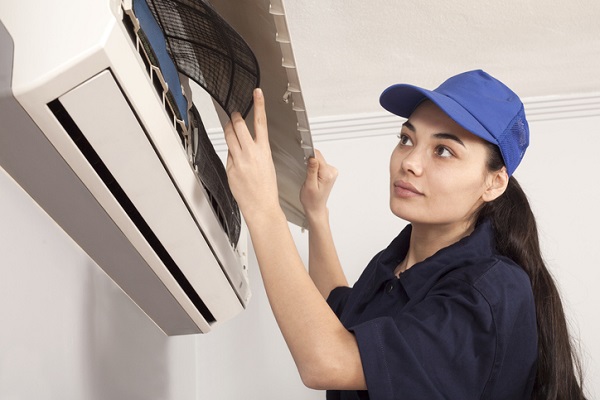
In HVAC training you will learn about fasteners, tools, codes and regulations as well as other knowledge and skills that are required for the job. However, one skill that you should not overlook is time management. If you’re looking to break into the HVAC industry, managing your time effectively can help you succeed.
Time management skills allow you to stay on track and are the best way to prepare for unexpected circumstances. Managing your time effectively also keeps you calm and reduces your stress, so that you are able to work in a focused, effective manner. Read on for more about why time management will matter in your career in the HVAC industry!
Your HVAC Career Will Be Full of Surprises
A major benefit of managing time effectively is that it helps you account for unexpected emergencies, calls and problems. In a job where you are servicing equipment and appliances, you may be called in for an issue and arrive only to discover that the problem is larger than you originally assumed it would be. This adds time to your task and delays the rest of your schedule.
If you’ve organized your day to allow for last-minute changes or service calls that run longer than expected, you’ve given yourself plenty of extra time so that you can still complete your day’s schedule. That way, if you find yourself in a situation where you need to pick up a part or change your strategy, you’ll have enough wiggle room to do so.
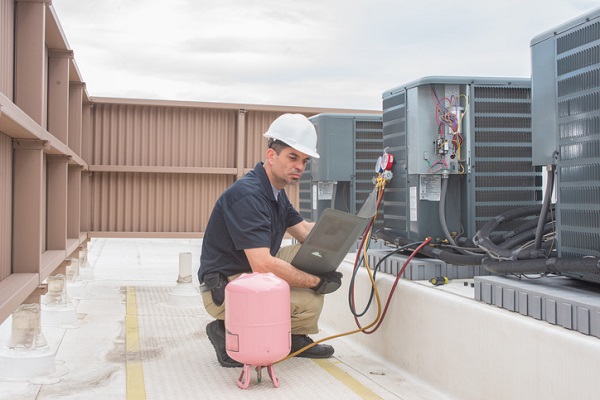
Time Management Helps You Save on Travel
When you are working in an HVAC career, throughout your day you may be required to travel to multiple locations that are quite dispersed. The more time you spend on the road, the less you can get done. This may cause your schedule to run behind or may not be an economical use of resources such as fuel. If you’re working with a team, failing to coordinate locations can cause unnecessary travel amongst employees.
Learning how to plan days in a way that makes sense for travel helps you manage your schedule. Establishing the most direct routes between locations is also helpful to save on time and costs, while ensuring that all of your goals for the day are accomplished.
Time Management Keeps Your Stress Levels Down After HVAC College
When tasks go unfinished or jobs are rushed, the quality of your work isn’t something you are likely to be proud of. This can cause your stress levels to rise and reduce your job satisfaction. After you have your HVAC diploma, you will want to show your skills and knowledge and perform to the best of your abilities. Making sure you have enough time and planning to finish what you’ve started helps you stay focused and healthy for a long and rewarding career. This also keeps you from constantly feeling time pressure or fearing that you won’t finish your work, which is another major stressor.
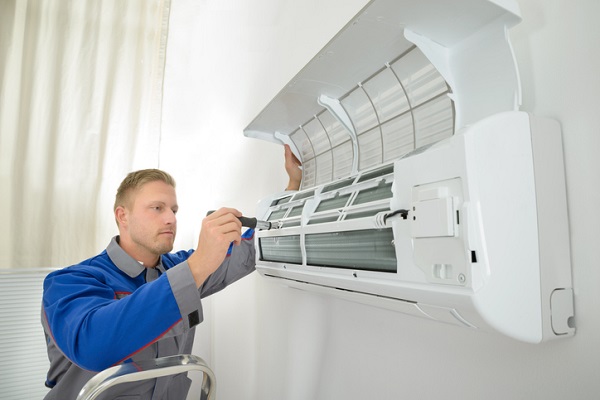
Scheduling extra blocks in your schedule allows you to thoroughly inspect situations and consider solutions, rather than applying quick fixes that won’t last as long. Not only will this help you stay focused and calm, it will make you a more successful professional because your work will be top-notch.
Are you interested in studying at HVAC college?
Contact North American Trade Schools to find out more!
3 Reasons Carpentry Assistant is a Great Career After Home Renovation Technician School
October 15, 2019

If you’re hard-working, love challenges and love working with your hands to get projects done, then becoming a carpentry assistant could be the right career choice for you. The field of home renovation covers various different crafts and trades, and carpentry is one of the most interesting among them.
In fact, working as a carpentry assistant has many advantages depending on what you are looking for in a job. Here are three reasons why becoming a carpentry assistant is a career path worth pursuing after your home renovation technician studies.
1. Carpentry Assistants Get to Tackle a Variety of Tasks
As a carpentry assistant, you might find yourself helping more experienced carpenters in performing a variety of tasks, such as safely using various tools, reading blueprints, and taking proper measurements. In certain carpentry assistant roles, you may also be expected to take care of duties such as ensuring that facilities are kept clean and machines are properly serviced, gathering and storing construction materials in shops or at construction sites, and helping to ensure that the worksite is kept safe for everyone. You may also be tasked with various drilling, cutting, planing, and other types of jobs with wood, lumber and paneling. This type of job can help give you plenty of experience in the carpentry trade after you’ve studied how to become a home renovation technician.

2. You Can Work on a Schedule That Isn’t the Typical 9 to 5 Day
Schedules can vary significantly in carpentry. Sometimes you can expect to find yourself starting the day around dawn, and working into the evenings to make sure projects can be completed in a timely fashion. That can mean more money in your pocket at the end of the day. At some places, you may work a short work week of just 4 days, while the workdays themselves will be longer. In other words, you can get a long weekend every weekend in those situations! Additionally, because of extenuating circumstances like project delays or weather, the length of the work week and work days can change with little notice. While that sort of schedule doesn’t work for everyone, if you’re someone who wants to avoid the monotony of the typical 9 to 5 workday, then working as a carpentry assistant could be a great choice.
3. Your Home Renovation Technician Training Could Lead You to Various Work Environments
You’ll learn a lot about carpentry during home renovation technician training and you will afterwards be able to take those skills and apply them in different work environments. On some projects, those working in carpentry could find themselves working on construction or remodeling projects with residential homes or commercial offices. Carpentry assistants are also required on big projects, such as highways, bridges, and ships. You may be surprises to learn that carpentry assistants are also found on film and television shoots, as those projects need carpenters and assistants on hand to help build sets and take care of various maintenance duties. Whatever the project may be that you work on, it’s clear that a career in carpentry can take you down many interesting paths.

Want to attend home renovation technician school?
Contact North American Trade Schools to learn more!
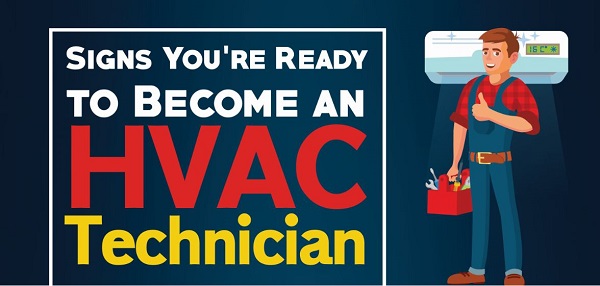
Have you been thinking about pursuing a new career? Perhaps you’re stuck in a rut at your current job or you’re just out of school and looking at potential career paths. Whatever your reasons, pursuing a career as an HVAC technician could be an excellent choice for you.
HVAC technicians are in demand in Ontario. Here, population and economic growth is leading to lots of new construction of both residential and commercial buildings. That means if you become an HVAC technician, you have opportunities to work in a wide variety of exciting settings in Ontario.
If you’re wondering about whether you’re the right fit for an HVAC career, there are fortunately a few ways to find out. HVAC technicians are hands-on people. They love working with machines, solving problems, and they certainly aren’t afraid of getting a little dirty from time to time. Plus, many HVAC technicians love the satisfaction of knowing they’re helping to keep people comfortable and safe.
Check out this useful infographic for signs that becoming an HVAC technician may be for you!
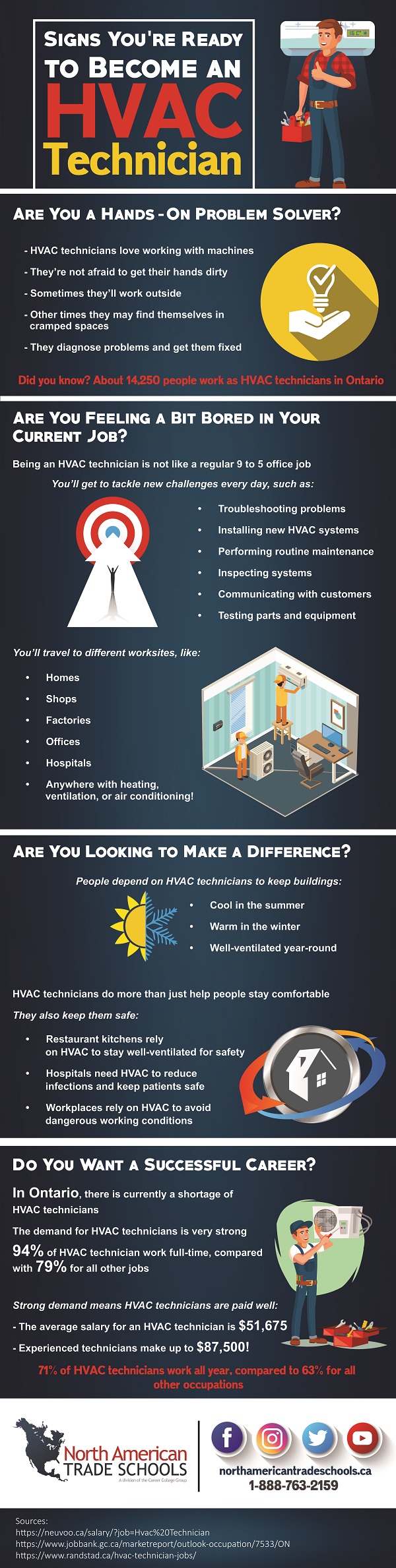
Signs You’re Ready to Become an HVAC Technician
Are You a Hands-On Problem Solver?
HVAC technicians love working with machines
They’re not afraid to get their hands dirty
Sometimes they’ll work outside
Other times they may find themselves in cramped spaces
They diagnose problems and get them fixed
Are You Feeling a Bit Bored in Your Current Job?
Being an HVAC technician is not like a regular 9 to 5 office job
You’ll get to tackle new challenges every day, such as:
- Troubleshooting problems
- Installing new HVAC systems
- Performing routine maintenance
- Inspecting systems
- Communicating with customers
- Testing parts and equipment
You’ll travel to different worksites, like:
- Homes
- Shops
- Factories
- Offices
- Hospitals
- Anywhere with heating, ventilation, or air conditioning!
Are You Looking to Make a Difference?
People depend on HVAC technicians to keep buildings:
- Cool in the summer
- Warm in the winter
- Well-ventilated year-round
HVAC technicians do more than just help people stay comfortable
They also keep them safe:
- Nursing homes need HVAC to protect residents on cold or hot days
- Restaurant kitchens rely on HVAC to stay well-ventilated for safety
- Hospitals need HVAC to reduce infections and keep patients safe
- Workplaces rely on HVAC to avoid dangerous working conditions
Do You Want a Successful Career?
In Ontario, there is currently a shortage of HVAC technicians
The demand for HVAC technicians is very strong
94% of HVAC technician work full-time, compared with 79% for all other jobs
Strong demand means HVAC technicians are paid well:
The average salary for an HVAC technician is $51,675
Experienced technicians make up to $87,500!
Sources:
https://www.jobbank.gc.ca/marketreport/outlook-occupation/7533/ON
What Electrician Diploma Students Should Know About Reading Layouts
October 08, 2019
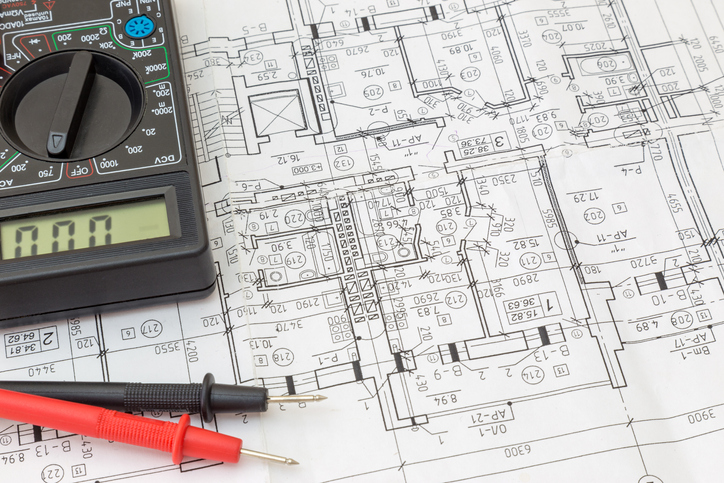
As an electrician (particularly a construction electrician), it’s important to be able to understand how to read electrical blueprints or layouts. With these layouts, you will have a better understanding of how electrical systems are to be built, and where all the various parts (eg. light fixtures, switches, wires) need to go. That said, they can be a bit complicated to look through at first. Luckily, it’s easier to get the hang of than you might think.
Regardless of all the symbols and more specialized aspects you may encounter while reading them, there are ways you can effectively interpret an electrical plan without too much trouble. Here’s what you should know about reading layouts if you’re studying to become an electrician.
Read What’s in the Architectural Layout Before the Electrical One
When you look at the floorplan for the building’s architectural layout first, you’ll get a good sense of how much space you have to work with, where things are, and where electrical parts should logically go. Not only that, but you’ll have information about the layout that isn’t necessarily in the electrical portion of the plan. This can help you identify potential conflicts between the architectural and electrical plans that you may not have noticed by only looking at the electrical plan. Either way, you’re going to need to understand what sort of parameters and space you have to work with, since you’ll have to work within them to make sure all the wires are in the right place and able to deliver power throughout the building in ways that are safe for everyone and compliant with bylaws and regulations.
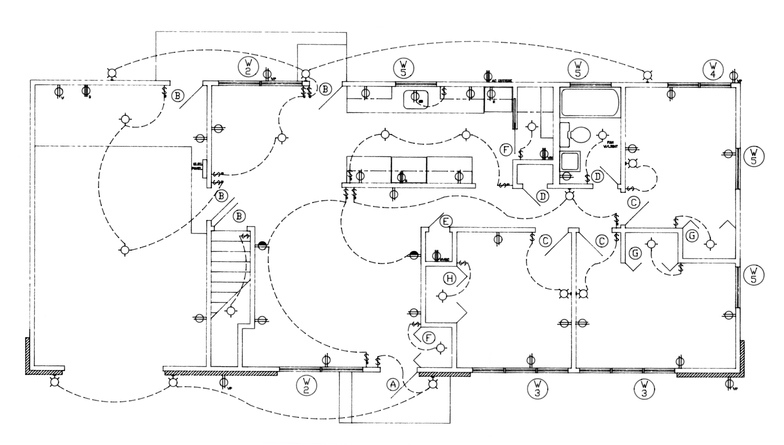
Familiarize Yourself With the Wiring Diagrams and Symbol Legend Before Getting Started
In many electrical layouts, there will be symbols representing various parts, and it’s important to study the symbol legend before you start working. Once you understand the symbols legend, you’ll be able to work faster and more efficiently. The legend will help you understand what the symbols are, what they mean, and where various components need to be. The plans for the project’s electrical components will also likely show diagrams of the paths the wires will take between the different pieces of equipment—important to keep in mind since you will be learning about residential wiring in your maintenance electrician training. This will show you the breakers running each wire, as well as which items within the house (eg. lights) are grouped or phased together onto one breaker.

Your Electrician Training Will Help You to Read Blueprints
All instructions of the electrical layout have to be followed exactly as written—or drawn—and sometimes the information presented can be overwhelming and will require specialized knowledge on electrical components. For example, you’ll need to understand how power across lines will be distributed, as well as the circuit’s flow and critical points where separate wires connect. It sounds like a lot to take in, but it is important information to remember so that the job is done effectively and so that fire, sparks or other hazards can be avoided. Fortunately, in electrician training you will learn how to read blueprints and building layouts, as well as the fundamental principles of electricity. At the end of the day, no part of the layout can be misinterpreted or ignored, and learning about plans and layouts will help you become a better electrician.
Want to get your electrician diploma?
Contact North American Trade Schools to find out more!
 Welding is a great job to have if you want to travel. Although you might not think it at first, a welding career can open up several different opportunities for travelling, in a number of different work environments. Working as a travelling welder—or “road warrior,” as they’re called—can be extremely exciting, and it also gives you the opportunity to demonstrate your knowledge of the craft in various locales.
With many situations in which those in the field can perform their duties while seeing various parts of the country, welding is a field with plenty to look forward to after your training. Here are three opportunities in the welding industry that can involve travelling.
You Can Pursue Work as an Underwater Welder
If you have a love for both welding and swimming and have a strong willingness to travel, this could be the ideal way for you to marry the two. By working as an underwater welder, you’ll be working in aquatic locales in rivers, lakes, and oceans to help repair or construct infrastructure, such as dams, oil rigs, pipelines, ships, bridges, and more.
Underwater welding is only for the most experienced of welders, and to get this job you’ll also need your diving certification, which you can pursue after your welding diploma. Since underwater welders are a relatively rare breed, this is definitely a career choice that could result in you travelling or relocating entirely.
You Could Also Become a Structural Welder for Industrial Buildings
As an industrial structural welder, you can travel between factories during shutdowns to repair or maintain industrial buildings and energy plants. In this kind of role, you can expect to spend a significant amount of time on the road, going to the facilities where your skills are required. Industrial shutdown work is often fairly easy to come by, even if major plants tend to have a limited period of being shut down (i.e., about a week or so). However, being able to travel frequently and for certain stretches of time could be a definite boost to your welder career—not to mention you’ll be helping manufacturers keep their plants running smoothly.

You Could Also Work at Shipyards or on Ships in Your Welder Career
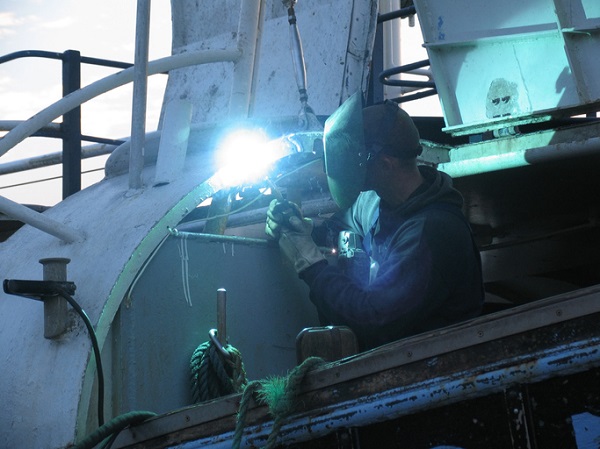
Becoming a welder in the shipping industry can also be an exciting opportunity if you’re intrigued by the idea of taking your skills out to sea. Not only is there plenty of variety to be found in the industry as a welder, but the breadth of locales you could find yourself working in can also make this kind of job a particularly rewarding one. You can help to construct various types of ships—in which case you would work in a shipyard—or you could do maintenance tasks onboard a ship, which can involve living on the ship while it is at sea. In either case, the locations where you could find yourself working can be wide ranging. Likewise, onboard maintenance welding jobs can result in you working in different countries often, such as if you’re working on a cruise ship or container ship.
Want to start your welding technician training?
Contact North American Trade Schools to learn more!

Cabinetmaking is a craft that combines the traditional art of carpentry with the most sophisticated woodworking instruments. For someone who enjoys woodworking, learning about cabinetmaking can open up exciting career opportunities. While cabinetmaking encompasses everything from the identification and selection of the finest wood, to the reading of designs, to the operation of woodworking equipment, one aspect remains perhaps the most critical: safety.
The skills that you learn in cabinetmaking school must be applied with safety always at the top of your mind. If you might be interested in a career as a cabinetmaker and you want to avoid injury, keep reading to learn some essential safety tips!
1. Where You’re Working is as Important as How You’re Working
When working in cabinetmaking, you might decide to eventually begin your own business or simply do some projects on the side in your workshop. Ensuring that the space you work in is safe should be a top priority.
If you, like many woodworking specialists, decide to set up your headquarters in your personal garage or on your property, you need to make sure that the space meets safety standards. You must consider suitable ventilation, fire hazards, and emergency protocol. Remember that while you may not be in a commercial shop, you too must take safety just as seriously if you decide to go out on your own after cabinetmaking school!
2. What You Wear Can Help Protect You from Safety Hazards
Every woodworker should have the right personal protective equipment (PPE) to wear. While sporting the appropriate PPE might seem an obvious recommendation, injuries as a result of non-adequate protection represent a significant percentage of woodworking injuries. One of the reasons for this, ironically, is expertise. Sometimes, when a professional feels overly confident in their abilities, they decide to omit some of the basic PPE. And although they have achieved mastery of their craft, certain things cannot be predicted regardless of experience. A malfunctioning piece of equipment kicking back and chipping a particle of wood or metal into an unprotected eye can cause irreversible damage!

When you’re equipping yourself for the job, make sure you also pay special attention to:
- Clothing (avoid baggy, floating clothes that might get caught in the machinery)
- Jewelry (a long chain of loose bracelet might also be a hazard)
- Hair (if you’ve got long hair, make sure it’s tied up so it doesn’t get caught in the equipment)
3. Get to Know Your Tools and Equipment in Cabinet Making Training
Another important aspect of safe woodworking practice is the equipment that you are using. You’ll learn in cabinet making training about how to safely use woodworking tools and equipment. You should know what tool is required for what job, and you should know how that tool can be used most effectively. You should always verify that the tool is in adequate condition. For example, there is common a misconception that a sharp blade is more dangerous than a dull blade when, in fact, a dull blade risks getting caught or kicking.

Soliciting help is another important part of safety. If you are operating a tool with which you have little experience, or if you know that a specific task will be easier with the assistance of a fellow woodworker, then it might be a good idea to get help. Be careful, however, to only get help from people who are properly trained!
Are you interested in cabinet making courses?
Check out North American Trade Schools to learn about our programs.