Stick Welding
Build foundational Shielded Metal Arc Welding (SMAW) skills through instructor-led classroom learning, demonstrations, and supervised welding shop practice.
Your Stick Welding Training at a Glance
Get an introduction to SMAW through technical instruction, instructor demonstrations, and extensive supervised welding practice.
Total Hours
A focused introductory workshop covering SMAW theory and practical skills.
Practical Hours
Supervised hands-on welding shop training.
Theory Hours
Technical instruction, safety and instructor demonstrations.
In-Person
Classroom instruction combined with welding shop training.
Beginner Level
No previous welding experience required.
Locations
Brampton, Burlington and London.
Build Practical Stick Welding Skills
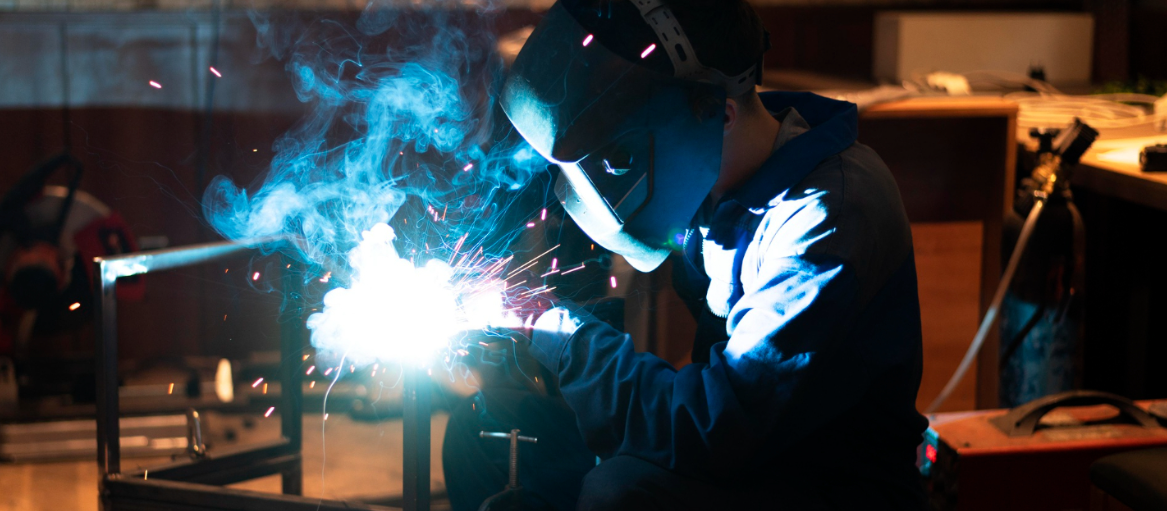
Shielded Metal Arc Welding (SMAW), commonly known as Stick Welding, is a manual arc welding process that uses a consumable, flux-coated electrode to create the welding arc.
As the electrode melts, it supplies filler metal while the flux coating protects the molten weld pool and produces slag that is removed after welding.
During this 80-hour workshop, students learn through classroom instruction, instructor demonstrations and supervised hands-on welding practice.
Training emphasizes flat and horizontal welding on mild steel, with introductory vertical and overhead exercises as student readiness permits.
- Welding safety and PPE
- SMAW equipment and operation
- AC, DC and polarity
- Electrode classifications and selection
- Material and joint preparation
- Arc initiation and control
- Electrode angle and travel speed
- Basic fillet and groove welds
- Slag removal and weld cleaning
- Basic visual weld inspection
- Welding symbols and drawings
Understand How Stick Welding Works
Learn how the welding circuit, electrical current, flux-coated electrode and welding technique work together during Shielded Metal Arc Welding.
Understanding the SMAW Welding Circuit
Learn the relationship between the welding power source, electrode holder, flux-coated electrode, welding cables, work clamp and workpiece.
AC, DC and Polarity
Explore alternating current (AC), direct current electrode positive (DCEP) and direct current electrode negative (DCEN), including how electrode specifications influence settings.
Understanding Stick Welding Electrodes
Learn about common SMAW classifications such as E6010, E6011, E6013 and E7018, including electrode characteristics, applications and handling requirements.
What You'll Be Able to Do
Upon successful completion, students should be able to demonstrate foundational SMAW knowledge, safe equipment operation, joint preparation and basic welding techniques.
Safety & Equipment
- Identify common welding hazards.
- Apply appropriate safety controls.
- Select and correctly use PPE.
- Inspect welding cables and equipment.
- Apply safe electrical work procedures.
- Set up and operate SMAW equipment safely.
- Handle hot metal and remove slag safely.
- Shut down welding equipment correctly.
SMAW Process Knowledge
- Explain the basic SMAW process.
- Identify welding circuit components.
- Explain introductory AC and DC applications.
- Understand electrode classifications.
- Select electrodes for assigned exercises.
- Explain the function of electrode flux.
- Understand basic amperage and polarity selection.
Setup & Welding Technique
- Clean workpieces and prepare joints.
- Install and secure suitable electrodes.
- Set welding amperage appropriately.
- Strike and maintain the welding arc.
- Control arc length and electrode angle.
- Control travel speed and bead placement.
- Understand basic heat input.
- Remove slag and clean completed welds.
Welding & Interpretation
- Produce basic stringer beads.
- Practise introductory weave beads.
- Produce basic fillet and groove welds.
- Weld in flat and horizontal positions.
- Explore introductory vertical and overhead positions when appropriate.
- Identify common visible weld discontinuities.
- Interpret basic welding symbols.
- Read simple fabrication drawings.
What You'll Practise in the Welding Shop
Apply SMAW concepts through instructor-supervised practical exercises in a welding shop environment.
Equipment Setup
Inspect the welding machine, electrode holder, cables and work clamp before operation.
Safety & PPE
Apply safe welding practices and correctly use appropriate personal protective equipment.
Electrode Selection
Identify common electrode types and select electrodes for assigned exercises.
Amperage & Polarity
Practise configuring welding current and polarity using approved procedures.
Material Preparation
Clean metal surfaces and prepare basic welding joints.
Arc Initiation
Practise striking and maintaining a stable welding arc.
Arc Length & Angle
Develop electrode positioning and arc-length control techniques.
Travel Speed
Practise bead consistency, travel speed and heat control.
Flat Welding
Develop fundamental SMAW skills through flat-position exercises.
Horizontal Welding
Build experience controlling weld beads during horizontal welding.
Fillet & Groove Welds
Practise basic fillet and groove welding techniques.
Slag Removal & Inspection
Safely remove slag and inspect completed welds for visible discontinuities.
More Time Welding. More Time Building Skills.
Move from understanding SMAW fundamentals to developing practical welding skills through extensive supervised shop training.
Theory Hours
Safety instruction, SMAW fundamentals, electrode selection, welding procedures and instructor demonstrations.
Practical Hours
Supervised hands-on Stick Welding, equipment setup, electrode handling, weld bead development, joint preparation and basic inspection.
75% of Instructional Time is Supervised Practical Training
Of the 80 instructional hours, 60 hours are dedicated to supervised practical training.
From Equipment Setup to Finished Weld
Understand the steps involved in preparing equipment, selecting electrodes and completing a Stick Welding exercise.
Inspect Equipment & PPE
Check welding equipment, protective equipment and work area conditions.
Prepare the Workpiece
Clean the metal and prepare the required welding joint.
Select the Electrode
Choose an electrode appropriate for the assigned welding exercise.
Configure Machine Settings
Set amperage and polarity according to approved instructions.
Strike the Arc
Initiate the arc and practise maintaining suitable arc length.
Complete the Weld
Control electrode angle and travel speed while producing the weld bead.
Clean & Inspect
Remove slag safely and review the weld for visible discontinuities.
Build Skills Across Common Welding Positions
Flat
Build fundamental SMAW technique while welding in the flat position.
Horizontal
Practise electrode angle, arc length and travel speed in horizontal exercises.
Vertical
Explore introductory vertical welding as student readiness permits.
Overhead
Explore introductory overhead welding under instructor supervision when appropriate.
Understand Stick Welding Electrodes and Materials
Develop an understanding of mild steel welding, common electrodes and appropriate electrode handling procedures.
Mild Steel
Training focuses on prepared mild steel workpieces for foundational flat and horizontal SMAW exercises.
Flux-Coated Electrodes
Learn about common SMAW electrode classifications, their operating characteristics and suitable applications.
Electrode Handling & Storage
Understand proper electrode handling, manufacturer-recommended storage practices and moisture considerations.
Learn to Recognize What a Good Weld Looks Like
Students are introduced to visual weld inspection and common welding discontinuities.
- Weld appearance
- Bead consistency
- Weld profile
- Slag inclusions
- Undercut
- Porosity
- Incomplete fusion
- Possible causes of defects
Learn the Language of Welding
Students learn introductory technical terminology used to communicate welding requirements.
- Basic welding terminology
- Electrode classifications
- Welding symbols
- Joint identification
- Fillet welds
- Groove welds
- Fabrication drawings
- Welding positions
Course Completion and Welder Qualification
Understand the difference between completing introductory Stick Welding training and achieving formal welder qualification.
Certificate of Completion
Students who meet the school's approved completion requirements may receive a Certificate of Completion from North American Trade Schools.
What Course Completion Means
This workshop provides introductory SMAW knowledge and practical skills training.
- Completion of approved NATS workshop requirements
- Foundational SMAW theory and practice
- Supervised welding shop experience
- Completion of the workshop learning outcomes
What Course Completion Does Not Mean
Course completion is separate from formal welder qualification.
- It does not automatically provide CWB certification.
- It does not automatically confer formal welder qualification.
- Formal qualification testing follows separate requirements.
- Applicable standards and testing organizations establish qualification requirements.
Is This Stick Welding Workshop Right for You?
Beginners
People interested in learning Stick Welding with little or no previous experience.
Skilled-Trades Explorers
Individuals exploring skilled trades and seeking practical welding experience.
Workers
People looking for introductory experience with Shielded Metal Arc Welding.
Tradespeople
Individuals interested in expanding their understanding of SMAW equipment and technique.
Hands-On Learners
People who prefer substantial supervised welding shop practice.
No Experience Required
The workshop is designed at an introductory level.
80 Hours of Instructor-Led Training
The workshop includes 80 instructional hours, excluding breaks.
8-Hour Sessions
A concentrated format across ten training sessions.
4-Hour Sessions
A shorter-session format across twenty training sessions.
Train at a NATS Campus
Ask about Stick Welding workshop availability at participating North American Trade Schools locations.
Brampton
Learn SMAW through technical instruction, instructor demonstrations and supervised practical training.
Ask About Brampton ClassesBurlington
Build foundational Stick Welding skills through classroom learning and welding shop exercises.
Ask About Burlington ClassesLondon
Explore introductory Shielded Metal Arc Welding through theory, demonstrations and hands-on training.
Ask About London ClassesStick Welding Skills Covered in the Workshop
SMAW Fundamentals
- SMAW principles
- Welding circuit
- AC and DC
- Polarity basics
- Welding safety
Equipment & Setup
- Equipment inspection
- Welding machine operation
- Electrode selection
- Amperage settings
- Equipment shutdown
Stick Welding Technique
- Material cleaning
- Joint preparation
- Arc initiation
- Electrode angle
- Arc length
- Travel speed
- Heat input
Weld Types & Positions
- Stringer beads
- Basic weave beads
- Fillet welds
- Groove welds
- Flat welding
- Horizontal welding
- Introductory vertical and overhead welding
Electrodes & Materials
- Mild steel
- Electrode classifications
- Flux coating
- Electrode handling
- Electrode storage
Inspection & Qualification
- Visual weld inspection
- Weld discontinuities
- Welding symbols
- Simple fabrication drawings
- Course completion vs. formal qualification
Frequently Asked Questions
What is Shielded Metal Arc Welding?
Shielded Metal Arc Welding (SMAW) is a manual arc welding process that uses a consumable flux-coated electrode to join metal.
What does SMAW stand for?
SMAW stands for Shielded Metal Arc Welding.
Is SMAW the same as Stick Welding?
Yes. Stick Welding is the common name for Shielded Metal Arc Welding.
How does Stick Welding work?
An electrical arc forms between a flux-coated electrode and the workpiece. The electrode melts to deposit filler metal while the flux provides protection for the molten weld pool.
How long is the NATS Stick Welding workshop?
The workshop includes 80 instructional hours, excluding breaks.
How much of the workshop is hands-on?
The workshop includes 60 hours of supervised practical training and 20 hours of theory and demonstrations. This means 75% of instructional time is practical.
Do I need previous welding experience?
No. The workshop is introductory and beginner friendly.
What are the different Stick Welding electrodes?
Common SMAW electrode classifications include E6010, E6011, E6013 and E7018. Their uses, operating characteristics and handling requirements vary.
Will I learn about AC and DC welding?
Yes. Students are introduced to AC, DC and welding polarity as part of the SMAW fundamentals.
How do I choose the correct welding electrode?
Students learn introductory electrode selection based on the assigned material, welding position, operating requirements and manufacturer recommendations.
What welding positions will I practise?
Training emphasizes flat and horizontal welding. Introductory vertical and overhead welding may be included under supervision as readiness permits.
Will I learn flat and horizontal welding?
Yes. Flat and horizontal positions are the primary focus of practical training.
Does the workshop teach welding symbols?
Yes. Students are introduced to basic welding symbols and simple fabrication drawings.
Will I learn to identify welding defects?
Students are introduced to basic visual weld inspection and common visible weld discontinuities.
Do I receive a certificate after completing the workshop?
Students who meet the school's approved completion requirements may receive a Certificate of Completion from North American Trade Schools.
Does this workshop provide CWB certification?
No. Completing the 80-hour SMAW workshop does not automatically provide CWB certification or formal welder qualification. Formal qualification testing is separate.
Where is the Stick Welding workshop available?
The workshop information lists Brampton, Burlington and London. Contact NATS to confirm current campus availability and start dates.
What are the available workshop schedules?
Suggested formats include ten 8-hour sessions or twenty 4-hour sessions. Actual schedules vary by campus and instructional hours exclude breaks.
Ready to Start Welding?
Build foundational Shielded Metal Arc Welding skills through 80 hours of instructor-led classroom instruction, demonstrations and practical shop training.
60 Hours of Supervised Practical Welding Training gives students substantial time to develop introductory SMAW skills.